Over the past month, a series of discoveries have shaken the world regarding Canada’s history with the Indigenous people. On May 28/2021, the bodies of 215 children were found in Kamloops British Columbia at a former residential school. As this news spread across the country of Canada and the world it had brought forth a discovery of remains of other children at former residential schools across Canada in provinces such as Saskatchewan and Quebec. Alongside the recent event reflecting Canada’s previous relationship with the indigenous community, it is also interesting to see that Canada still has not fully respected the Indigenous peoples’ sayings in matters pertaining to the economy and politics of the nations. For example, such can be seen with how the Indigenous people’s opinion is disregarded as the government continues to construct the trans-Canada pipeline. Also, there are incidences of racism that the Indigenous community faces that are not presented to the wider masses in the media and the lack of funding that is provided to the Indigenous communities. From Canada’s history, it is interesting to see that the media had not been very representative of the Indigenous peoples’ rights in the past. However, as the model of media has transformed over the past decades it has also changed the methodology to bring about social change compared to a traditional perspective. The media has now become accessible to individuals from different walks of life that allows one to express how they feel and let their message be heard on a global level. Moreover, with the transformation of media, it can work as a powerful tool for the Indigenous Community to present the injustices they are facing in today’s society in an authentic manner instead of mainstream media which follows a series of political and economic agendas.
Before looking at how media has transformed to play an instrumental tool for Indigenous people against mainstream media as a platform to voice the injustices they are facing it is important to look at the relationship between media in the past. Unlike in the present day where media is found on social apps, platforms, electronic devices, and news broadcasts. In the past media was widely presented through newspapers, journals, and telegrams. It is interesting to observe that in the contemporary society of the past the media representation of the Indigenous Communities was very stereotypical and derogatory with a clear political agenda of the government. For example, among many goals of the Canadian government in the past was to assimilate the indigenous community. In order for such a message to reach the wider audience of Canada newspapers such as Grip Magazine presented cartoons that portrayed the Indigenous people to be a culture moving backwards and needs to be aligned with the European standard of the times. (HARDING, R. (2006). Historical representations of aboriginal people in the Canadian news media. Discourse & Society, 17(2), Page 215).

Canadian Media in the past of the 17th to 19th century was very direct in their approach of presenting Indigenous people in a degrading manner for the government’s political agenda. Moreover, it is very rare to find news articles in the past that present the injustices the Indigenous people were facing such as with the Residential school and the discriminatory policies but rather presented in a manner that was applauded by the public. It is interesting to see that the media representation in presenting the First Nation’s injustices were never given fair presentations and this had been the case for the vast majority of the time until recently.
Looking at the transition of media from newspapers to media on hand-held devices, television, and the radio there still appears to be a lack of fair representation of the Indigenous community and the injustices it is facing on a national level. For example, a study conducted that looked at news and media coverage of Indigenous people from 2010-2013 showed that there had not been a very drastic change in looking at the social issues being faced by the Indigenous community. From 2010 to 2013 they were “under-represented less than 0.5 percent online and print stories’ ‘(Indigenous coverage still insufficient; New report shows slow gains in media representation). Additionally, the news which was covered was negative in the sense that it created an unpleasant portrayal of the indigenous people in Canadian media. Among the most noticeable changes to have occurred regarding Indigenous people was that the Candian media shifted from using the term “indigenous” instead of “aboriginal”. Furthermore, it is also stated that the coverage of the indigenous community is 4 times less than what it should be compared to the Indigenous population in Canada. (Azzura Lalani Toronto Star, 2016, October 8, Indigenous Coverage still Insufficient; New Report Shows Slow Gains in Media Representation). Despite the transformation of media with the advancement of technology from the 19th century to the 21st century, the mainstream media has not been very supportive of Indigenous peoples but rather continued disregard what they are going through from using a direct approach of hateful representation to being subtle with picking certain news material to cover to create a certain idea in the Canadian society of making the issues faced by the Indigenous community not be very important.


The transformation of media shifting to being accessible to individuals from different parts of the world on their phones and social media platforms has allowed for it to become a network to facilitate social change. Social media has become a core tool to raise awareness about social issues from issues a person may be facing to a larger scale of a community facing injustices. In order to understand how the indigenous community can use social media as a tool as a platform to voice what they are facing it is important to look at the accessibility of the Indigenous community with social media. According to the 2011 census of Canada, it showed that 44 percent of Canada’s Indigenous population lived in remote areas that were not within the radius of urban centers (Azzura Lalani, 2016, October 8, Indigenous Coverage Still Insufficient; New Report Shows Slow Gains in Media Representation). With the location of indigenous communities living in remote areas, it has appeared to create a digital divide with a lack of internet access. Also, the weather conditions in the remote areas also provide challenges with thunderstorms causing damage to wireless towers and receiving dishes. Moreover, the socioeconomic status in the Indigenous communities also plays a crucial role regarding the Indigenous communities’ access to media. For example, in a study of Indigenous communities, there was a case of low literacy. Interestingly, the effect of low literacy has had a pessimistic effect on people’s views of social media where they may not feel motivated to learn how to navigate through smartphones and other social media apps (Intahchomphoo, C.2018. “Indigenous Peoples, Social Media, and the Digital Divide”: A Systematic Literature Review. American Indian Culture & Research Journal, 42(4), Page 93). Moreover, Indigenous communities may also be facing challenges to accessing social media due to economical constraints. For the use of social media, the main components required are the internet, wi-fi which is attained from users’ financial investments from phone companies and telecommunications companies. However, the Indigenous community may face economic constraints that prevent them from committing to financial investments that can allow them to access social media. (Intahchomphoo, C.2018. “Indigenous Peoples, Social Media, and the Digital Divide”: A Systematic Literature Review. American Indian Culture & Research Journal, 42(4), Page 93) Such restrictions that the indigenous community faces regarding their access to social networks present many issues of how effects of the past still carry weight with the communities. For example, the Indigenous communities were harassed and were made targets for European assimilation through cultural genocide and its effects are still visible to this day with issues such as economical restraints and poor access to resources that in return create hardships for the Indigenous community to present to the rest of the world what they are going through.
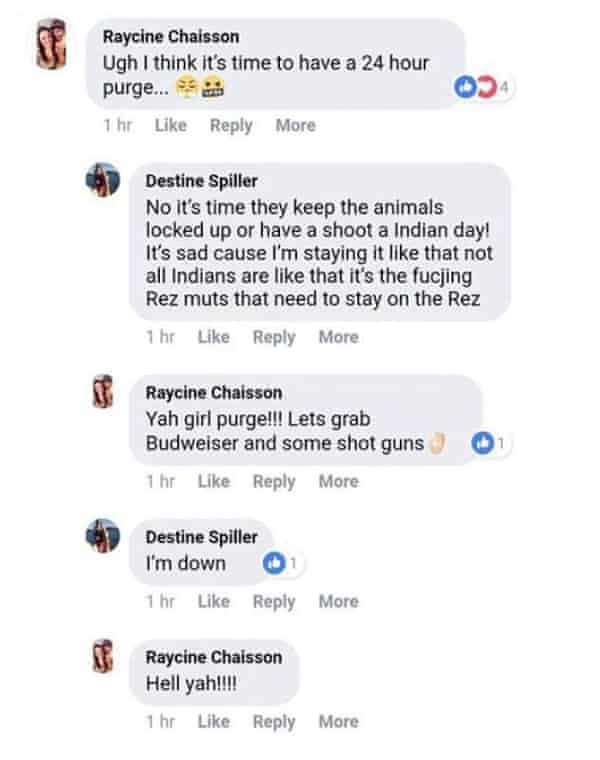
Social media has become a very strong tool that works to raise awareness of social issues, hold individuals accountable for hateful behavior, and also connect individuals from different backgrounds together for social change. For example in 2018 two women were arrested for posting comments on a Facebook posting saying “let’s celebrate shoot and Indian-Day” and then suggesting a “24-hour purge”. The two women then arrested for their hateful remarks towards the Indigenous people and were given a punishment of attending mediation circles to learn about the First-Nations community (Woman apologizes for racist comments on social media; Manitoban was arrested for threatening harm to Indigenous people, 2020, February 15, Spectator [Hamilton, Ontario]). Through looking at this event many things can be unraveled. For example, such an incident shows how racism is very prominent against Indigenous people and it is also prevalent on social media. Moreover, with social media, the spreading of hate can come with consequences where a person is held directly accountable for their actions. Although Social media is a great tool for raising awareness and creating a platform for social change it also has a negative side to it where people can engage in immoral behaviors spreading hate. Although the women in the Facebook comments expressed what they felt with their real identities, on a larger scale the internet has created anonymity where individuals engage in hate speech online under a false identity to avoid being held responsible (Reed, T. V., 2019, “What’s New About Digitized Identities?” In Digitized lives: Culture, power and Social Change in the Internet Era, Page 72). Routledge. Moreover, although social media can be beneficial to social movements not everyone may be supportive of the movement. In such cases on the online sphere, one can also witness cult-like behavior by anonymous individual spewing hate toward a certain individual leading movements or the movements in general through harassing the supporter and bullying them (Salter, M. ,2017, “From geek masculinity to Gamergate: The technological rationality of online abuse.” Crime, Media, Culture: An International Journal 14, Page 256). Another incident that took place in 2020 also reflected the discrimination and racism that the Indigenous people face in Canada. For example, in 2020 several non-indigenous commercial fishermen were tampering with a Mi’kmaq fisherman’s lobster equipment while shouting derogatory terms; however, the fisherman recorded the incident and posted it on his Facebook account. In return, the video of the incident spread to a wide number of people and reached the authorities where the fishermen were identified and charges pressed. (Mercer, G., 2020, December 15, “Four Men Arrested After Shots Fired at Indigenous Fishermen, RCMP Say”, Globe & Mail (Toronto, Canada). Such incidents reflect how Indigenous communities face racism and discrimination which is not found on mainstream media, however, social media has allowed more power in the hands of the people to call for action through displaying what they are going through.
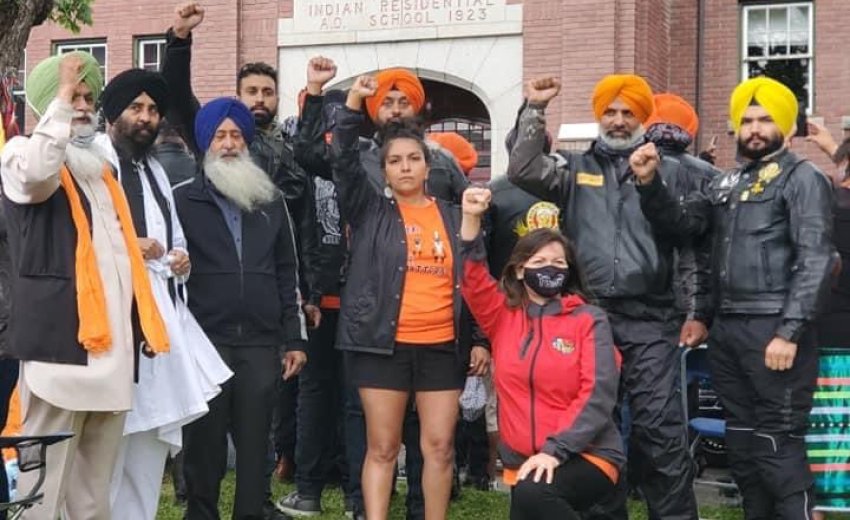
With The recent events of the 215 bodies being found at the former residential school in Kamloops, British Columbia there has been a lot of activity on social media regarding Canada’s past and injustices inflicted upon the Indigenous community. Posts on social media included launching an investigation into all the previous residential schools in Canada, investigating former records regarding the generations of the Indigenous people that went to the residential school, and petitions to hold the Canadian government responsible for its past decisions. With the recent events, there have been a series of gatherings and protests where individuals have got together and called for social change regarding Canada’s relationship with the indigenous people. It’s Interesting to note that the spread of news of the bodies found in the Kamloops spread heavily through social media and it continues to gain traction every day as compared to mainstream media. Moreover, the power of social media in getting movements to progress and connect individuals can be witnessed. Such movements regarding the Indigenous community are being spread widely through the use of social media. Moreover, the importance of social media and movements is important since it can create a large audience of individuals across the world creating worldwide momentum for social change. For example, the author of “Twitter and Tear Gas: The Power and Fragility of Networked Protest” Zeynep Tufekci mentioned how the vast majority of individuals in the Arab spring gathered through the spread of social media. Moreover, the movements were grassroots based from the power of the people which led to the removal of the draconian leaders of the nations ( Tufekci, Z. 2017, “Twitter and Tear Gas: The Power and Fragility of Networked Protest”, Page 28). Similarly, the use of social media in the Indigenous community has been raising a lot of awareness and connecting a vast amount of individuals to stand in solidarity with the Indigenous community unlike before under the mainstream media. For example, over the past few weeks, the Sikh Motorcycle club visited Kamloops to pay respect for the bodies found of the children and stand in solidarity which reached such a wide scale due to social media. Such movements for social change are fueled with social media that allow the indigenous community to present their voice to the world themselves instead of mainstream media that has been suppressing the indigenous voices over the years. Interestingly, with the recent discussion gaining influence regarding Indigenous sovereignty it is interesting to see how this has an impact on the trans-Canada pipeline which the Indigenous community opposes. For example, although there have been protests against the construction of the pipeline the mainstream media had not been very open to presenting such information to the public. Moreover, the individuals protesting are mostly from an Indigenous background protesting. With social media working as a tool for creating social change in Canada regarding the Indigenous communities rights and reconciliation as a large voice it is also informing many individuals of Canada’s history with the Indigenous community which can have a strong effect on people standing shoulder to shoulder with indigenous people also opposing the pipeline. Social media has become a strong tool that allows a voice for the Indigenous people to express what is happening to them and demand for social change while connecting other individuals forming an authentic grassroots movement without interference from mainstream media which may have a political and economic agenda suppressing such voices.

https://www.google.com/search?q=unity&tbm=isch&chips=q:unity,g_1:diversity:XQ_1NsRt3UE%3D&rlz=1C1GCEB_enCA840CA840&hl=en&sa=X&ved=2ahUKEwiw9ZzftKzxAhUkI30KHeX8BGAQ4lYoAXoECAEQGw&biw=1903&bih=937#imgrc=lUqdp-3qYkKGRM
While viewing how social media is very instrumental for social change and how it has raised awareness across the nations regarding the history of Canada with the indigenous people, social media can be improved in certain ways through creating a stronger messaging system for discussions. For example, the negative aspect of social media including anonymity and hate issues like those that interfere with raising awareness as they can tend to promote hate speech can be filtered with strong communication networks. Social media can be improved for social change with different networks that can allow individuals to express their views about certain topics and create an open dialogue without the fear of online harassment and bullying. A possible solution for such a goal can include setting policies with consequences for individuals who engage in hate speech. Moreover, having a more open and advanced platform to allow a discussion can bring clarity to certain movements and reasons for social change that can further progress a movement. For example, with the Tran-Canada Pipeline people could engage in a dialogue in a professional manner presenting certain views for why one feels a certain way and try to understand the other side’s perspective. Social media can be improved for social change through creating a network promoting outrospection of learning through looking at the world experiences and issues as well as emphasizing cognitive empathy which can allow an individual to get a better understanding of the other side and see from a different perspective better understanding the foundation for the social change.
From the past century until recent years the mainstream media of Canada has not been very supportive of Indigenous people in highlighting the injustices they face as well as educating the individuals living in Canada about the nation’s history. The transformation of media being accessible on a micro and macro level regarding social issues has allowed it to be a platform for the Indigenous people to express what they are going through without mainstream media suppressing their voice. Social media has allowed the news of the 215 bodies of the children being found spread across the nation and captured a large number of individuals from various walks of life regarding how Canada treated the Indigenous people and how they are being treated today. Although social media has raised a lot of awareness and presented a voice for the Indigenous community, there has been a negative side where there has been a lot of hate that is being spread on social platforms with anonymous profiles attacking the Indigenous community and trying to slow down the momentum for social change regarding the Indigenous community in Canada. Social media has connected individuals all across the nations to show their solidarity with the Indigenous community and is gaining more traction creating a grassroots type movement. Moreover, while looking at the Indigenous community and the use of social media for social change against mainstream media, a few ways media can be improved to further progress movements for social change can be with platforms encouraging and setting networks that allow for a formal dialogue between people to understand the opposing perspective which can further advance social movements.
References:
Azzura Lalani Toronto Star. (2016, October 8). Indigenous coverage still insufficient; New report shows slow gains in media representation. The Toronto Star (Toronto, Ontario), A14.
HARDING, R. (2006). Historical representations of aboriginal people in the Canadian news media. Discourse & Society, 17(2), 205-235. Retrieved June 19, 2021, from http://www.jstor.org/stable/42889043.
Intahchomphoo, C. (2018). Indigenous Peoples, Social Media, and the Digital Divide: A Systematic Literature Review. American Indian Culture & Research Journal, 42(4), 85–111. https://doi-org.proxy.ufv.ca:2443/10.17953/aicrj.42.4.intahchomphoo
Mercer, G. (2020, December 15). Four Men Arrested After Shots Fired at Indigenous Fishermen, RCMP Say. Globe & Mail (Toronto, Canada), A3.
Reed, T. V. (2019). “What’s new about digitized identities?” In Digitized lives: Culture, power and social change in the internet era (pp. 53-76). Routledge.
Wilson, A., Bronwyn Lee Carlson, & Sciascia, A. (2017). Reterritorialising Social Media: Indigenous People Rise Up, 1–5. https://doi.org/https://www.researchgate.net/publication/318559273_Reterritorialising_Social_Media_Indigenous_People_Rise_Up
Woman apologizes for racist comments on social media; Manitoban was arrested for threatening harm to Indigenous people. (2020, February 15). Spectator [Hamilton, Ontario], A7. https://link.gale.com/apps/doc/A613922134/CPI?u=abbo55004&sid=bookmark-CPI&xid=8f39d433.
Salter, M. (2017). “From geek masculinity to Gamergate: The technological rationality of online abuse.” Crime, Media, Culture: An International Journal 14(2), 247-264.
Tufekci, Z. (2017). Twitter and tear gas: The power and fragility of networked protest (pp. 3-48). Yale University Press.
Citations for Images used:
Division, Diversity, Unity. The Institute of World Politics. (2020, July 8). https://www.iwp.edu/articles/2020/07/07/division-diversity-unity/.
Gandham, Y. (2021, June 7). Sikh Riders of Canada Motorcycle Club ride in solidarity with Indigenous community. NEWS 1130. https://www.citynews1130.com/2021/06/06/bc-sikh-motorcycle-club-solidarity-indigenous/.
Guardian News and Media. (2018, August 1). Two Canadian women arrested for ‘shoot an Indian day’ social media posts. The Guardian. https://www.theguardian.com/world/2018/aug/01/canada-shoot-an-indian-day-facebook-arrested-first-nations-flin-flon.
Greaves, W., & Lackenbauer, W. (n.d.). First Nations, LNG Canada, and the Politics of Anti-Pipeline Protests. Canadian Global Affairs Institute. https://www.cgai.ca/first_nations_lng_canada_and_the_politics_of_anti_pipeline_protests.
The Grip Magazine. (June 20, 1885) (n.d.). What It must Come To. http://www.begbiecontestsociety.org/1st20.htm.
Trendall, S., & About the author Sam Trendall is editor of PublicTechnology. (2019, October 25). Digital minister: ‘Online anonymity is important’. PublicTechnology.net. https://www.publictechnology.net/articles/news/digital-minister-%E2%80%98online-anonymity-important%E2%80%99.
 Site Title